Worth remembering
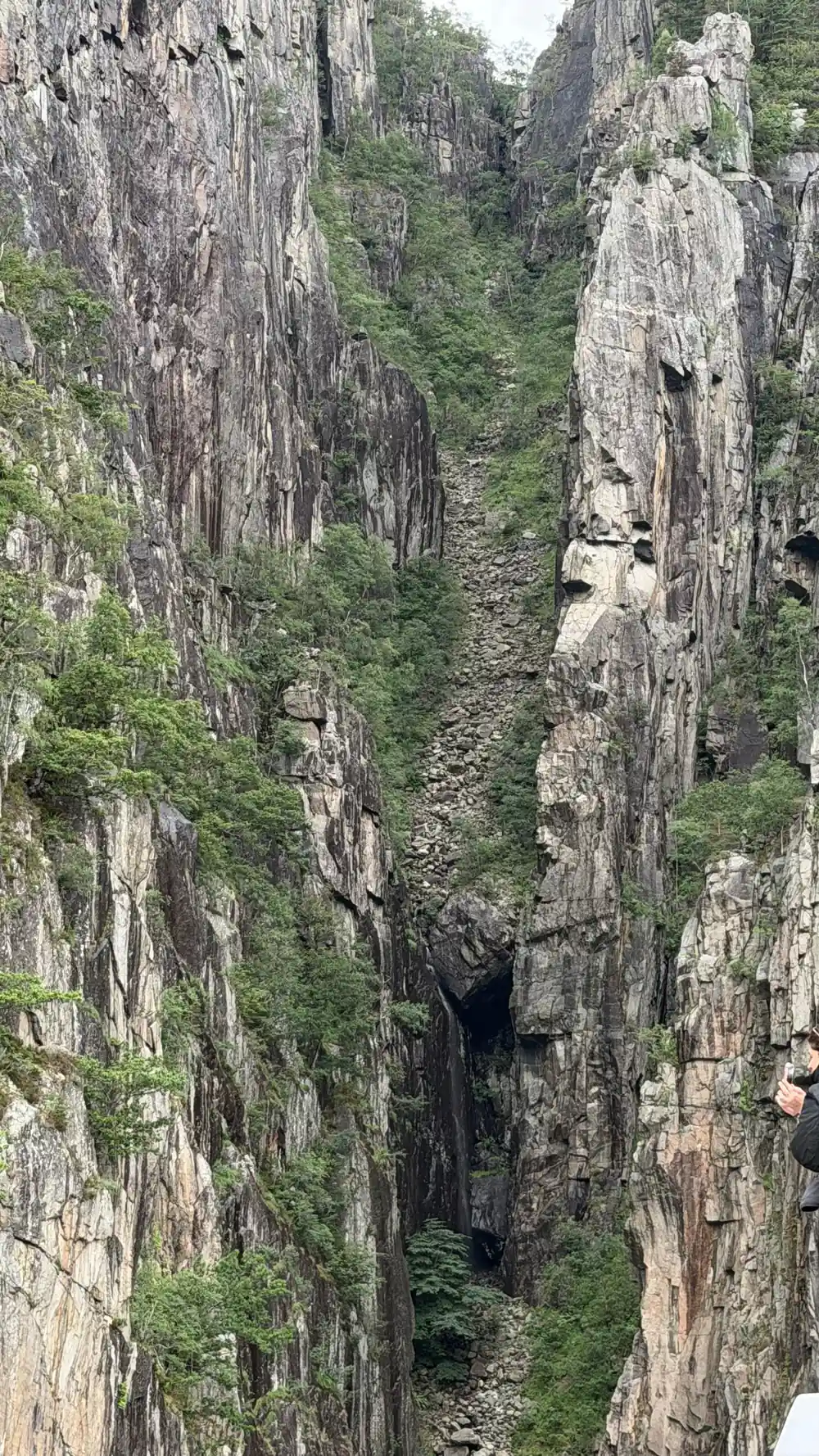
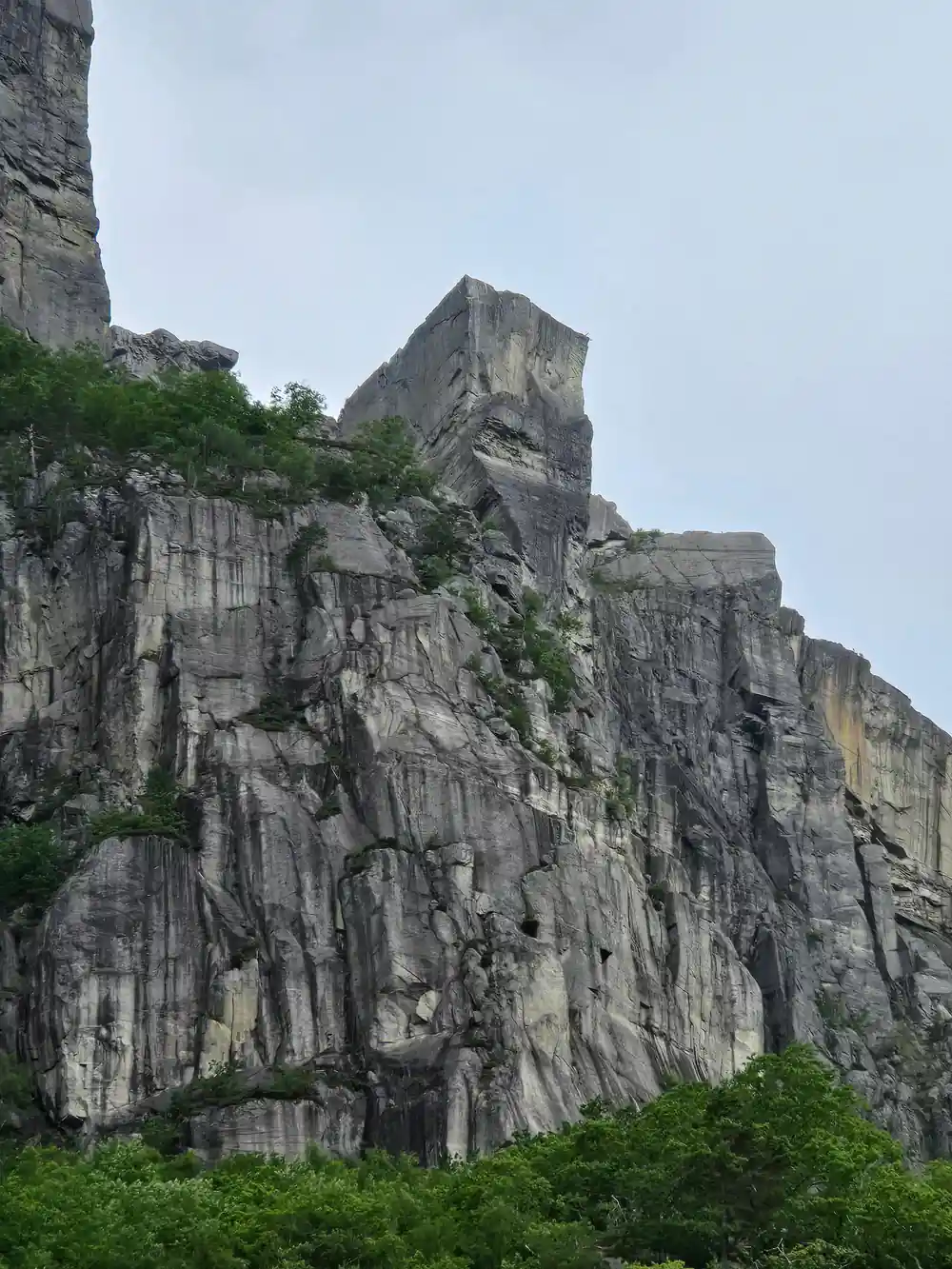
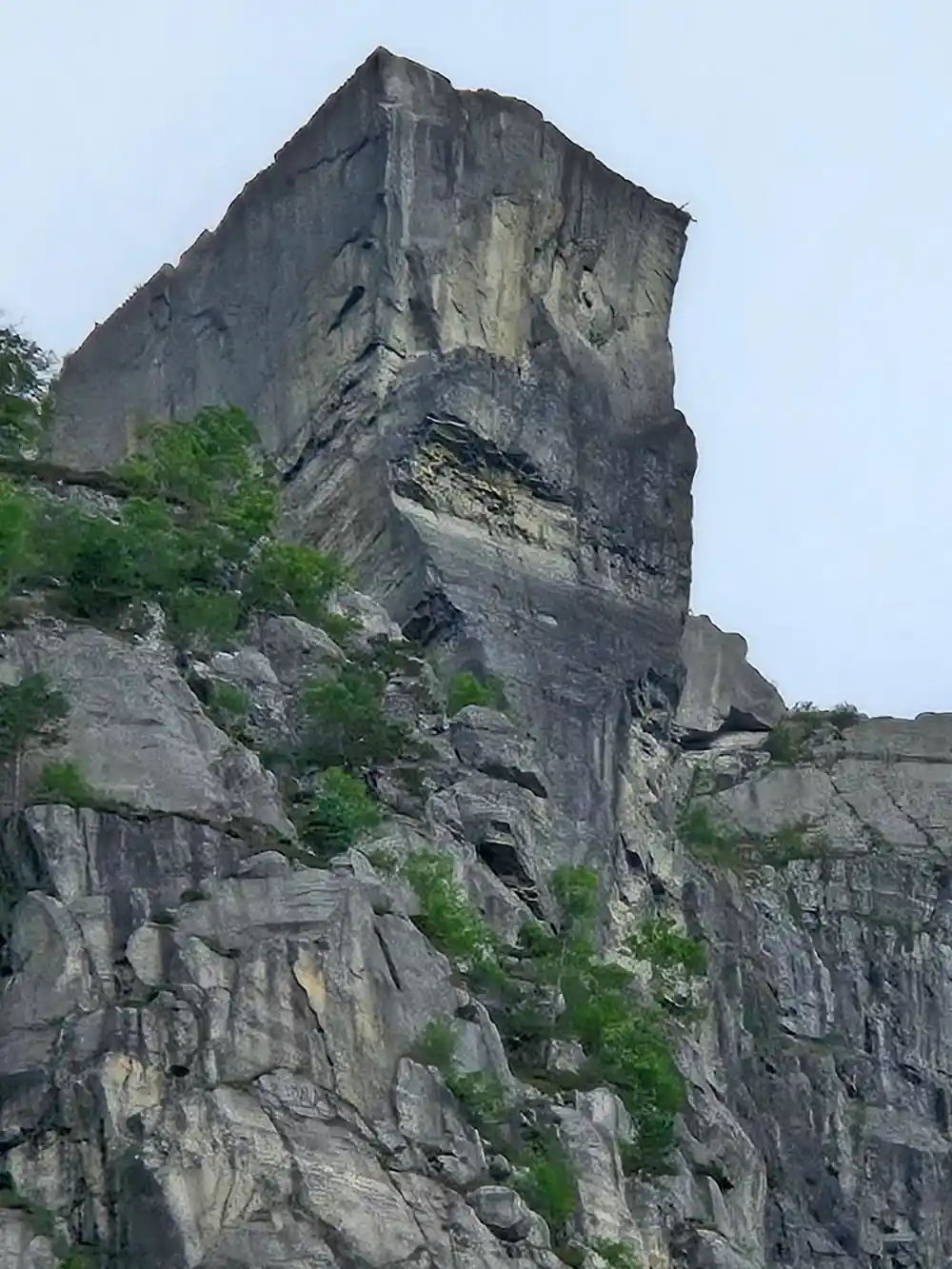
- A dark fissure runs across the rock at the back of the Preikestolen plateau, part of a cliff that rises 604 metres above the Lysefjord.[24]
- Glaciers carved the Lysefjord during the last Ice Age, about 10,000 years ago; the fjord is approximately 40 kilometres long today.[25][26]
- Hengjanefossen is reported at around 400 metres high, and the Flørli stairway climbs the mountain in 4444 steps.[27][28]
- A 3.5-hour silent, hybrid-electric cruise from Stavanger shows you Preikestolen from the water, from US$75.[29][30]
- The electric fjord cruise is rated 4.62 from 9,730 reviews, with value for money scored 4.3.[30]
- Top choice Electric fjord cruise from US$75 Duration3.5 hours[30]Rating4.62 from 9,730 reviews[30]Free cancellationUp to 24 hours in advance[30]PaymentReserve now, pay later[30] Check availability
- Low-emission cruise from US$76 Duration2.5 hours[31]Rating4.81 from 2,256 reviews[31]Free cancellationUp to 24 hours in advance[31]PaymentReserve now, pay later[31] See this tour
- RIB tour to Lysefjord from US$126 Duration2 hours[32]Rating4.92 from 1,526 reviews[32]Free cancellationUp to 24 hours in advance[32]PaymentReserve now, pay later[32] See this tour
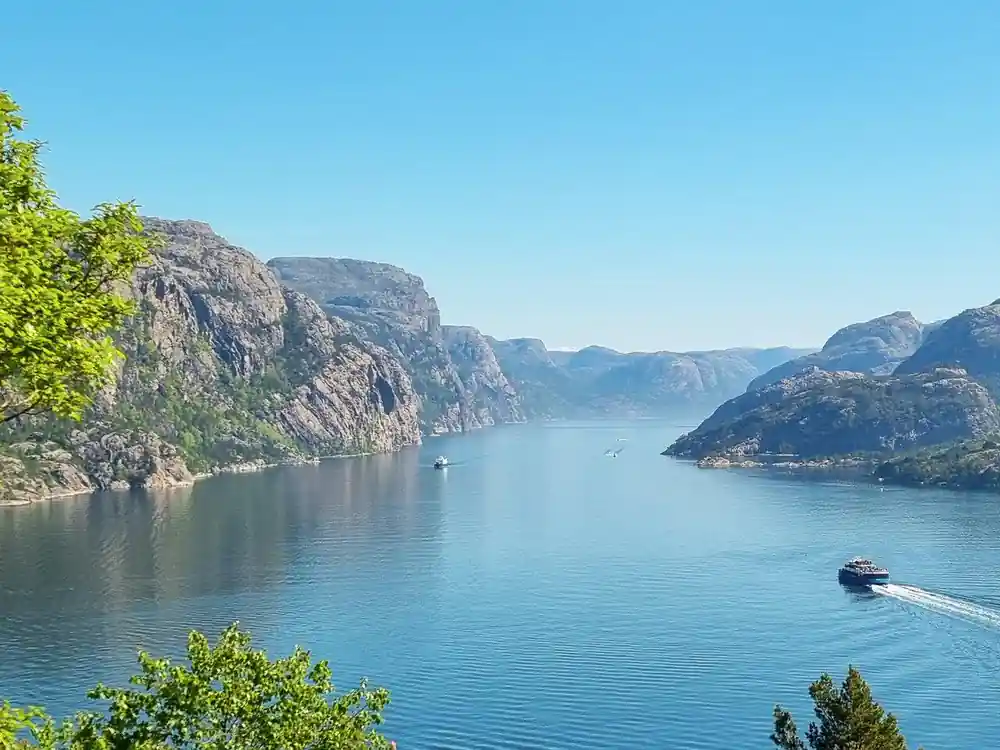
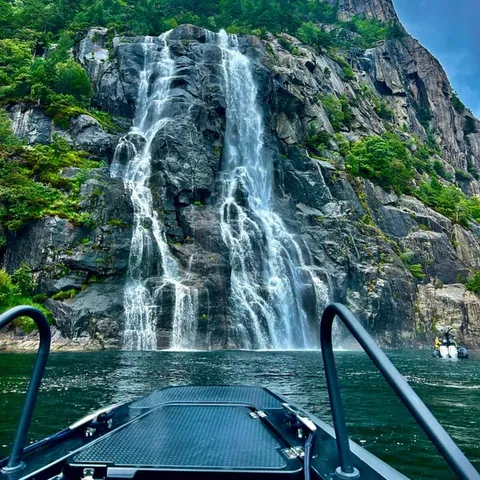
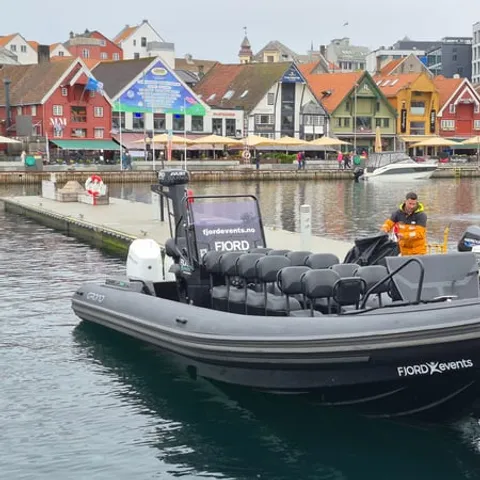
We cruise the fjords for 3-3.5 hours, giving you plenty of time to explore the scenic landscapes and capture beautiful photos.
Is the electric Lysefjord cruise worth it?
Pre-booking checklist
On the day
A fjord carved by ice
Lysefjord does not look like a valley that happens to have water in it. It looks like a slice taken out of the earth, with walls rising in near-vertical sheets and a floor a long way below the boat. The water sits dark and still in the middle, and the light changes every few minutes as you move between shadow and sun. Even travellers who have seen a great deal of Norway tend to go quiet on the first stretch out of Stavanger.
The shape comes from ice. The Lysefjord was formed during the last Ice Age, about 10,000 years ago, when colossal glaciers carved deep valleys into the landscape.[25] Those valleys later filled with sea water, and the result is the long, narrow channel you sail today. It is approximately 40 kilometres long and up to 422 metres deep, though it shallows to only 13 metres near Oanes and Forsand.[26] If you watch the colour of the water on the way out, that shallow sill near the mouth is part of what you are seeing.
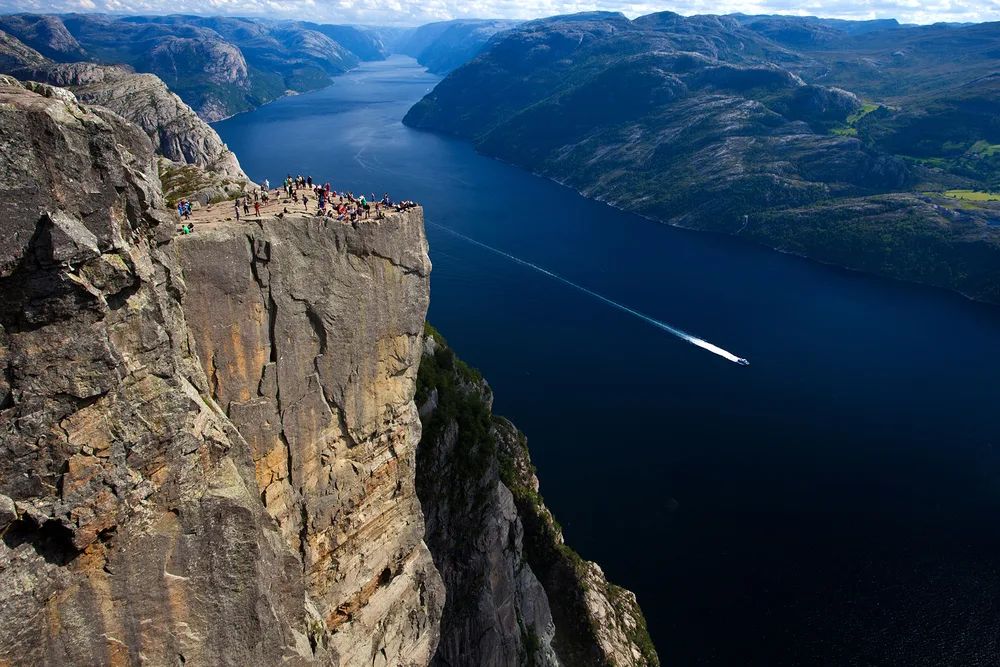
At the far end, the landscape puts on its main act. Preikestolen (the Pulpit Rock) rises 604 metres above the Lysefjord in Ryfylke, a flat-topped shelf of rock that ends in a sheer drop.[24] From the deck you see the whole face of it: the ledge, the dark streaks where water runs down the stone, and the birds turning in the air at the level of your head. From the top, the same view feels entirely different, which is a good argument for doing both.
The crack in the mountain
The Preikestolen crack measured over the years is a dark fissure running across the rock at the back of the plateau. It is the detail that makes people stop looking at the view and start looking at the ground. Up close you can see that the plateau is a block of stone rather than a smooth shelf, with joints and lines crossing it in several directions. The crack belongs to the story of the cliff rather than being a separate sight, and plenty of hikers step past it without noticing how near they have been.
Getting up there is a walk rather than a climb. The Preikestolen hike is less than 10km (6.2 miles) long with an elevation gain of just over 600m and takes about 3 to 4 hours to complete.[34] The path begins in birch woodland, climbs a long flight of stone steps built into the slope, and then opens onto bare rock with the fjord somewhere far below. Good shoes matter more than fitness. Most people find the descent harder than the climb, because the stone steps ask for attention all the way down.
The hiking trail to Preikestolen is open year-round, including during the winter off-season.[35] In the cold months the same path can be icy and the daylight is short, so a guided winter hike is the sensible choice unless you know the mountain well. One small-group winter hike to Pulpit Rock runs for 9 hours with a live English-speaking guide, from US$147, and is limited to 8 participants.[33]
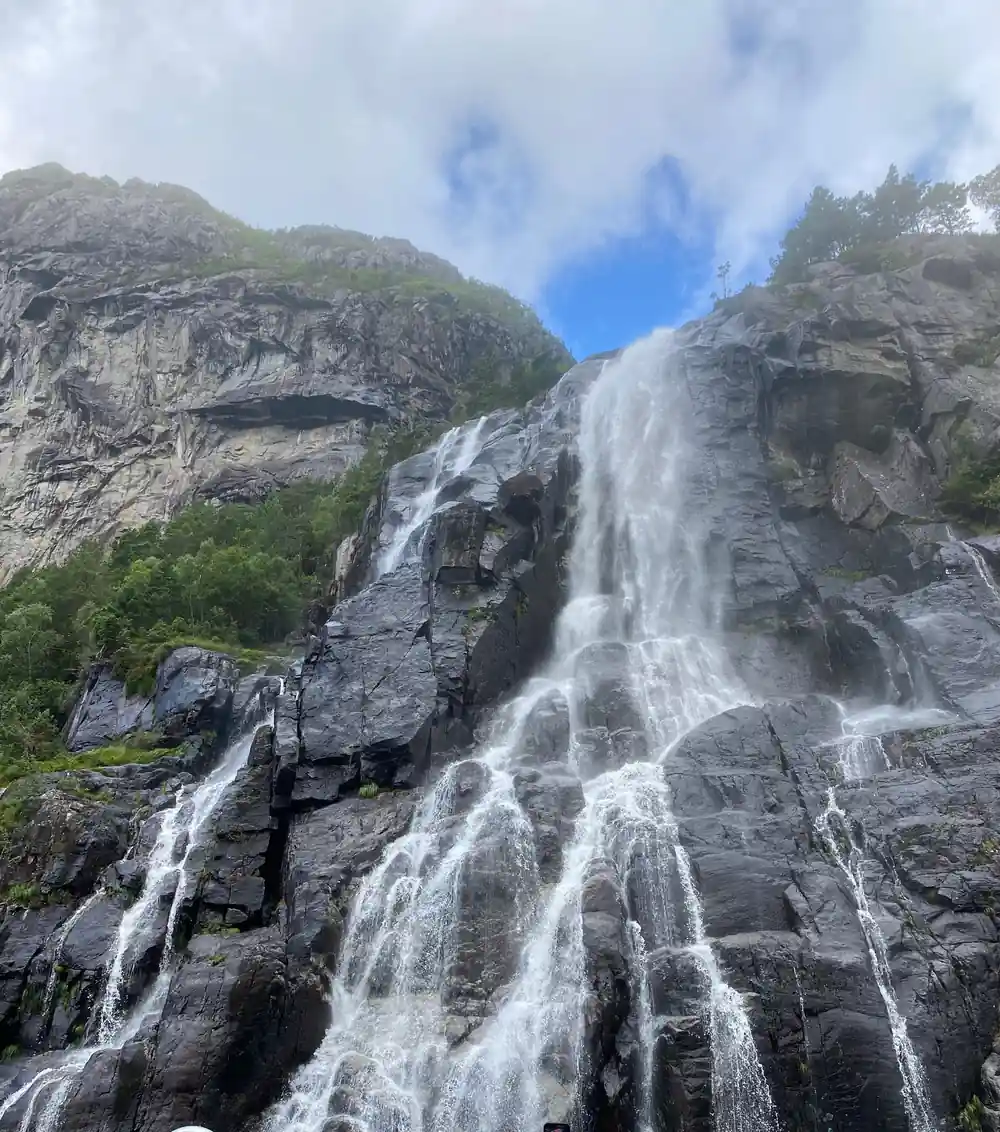
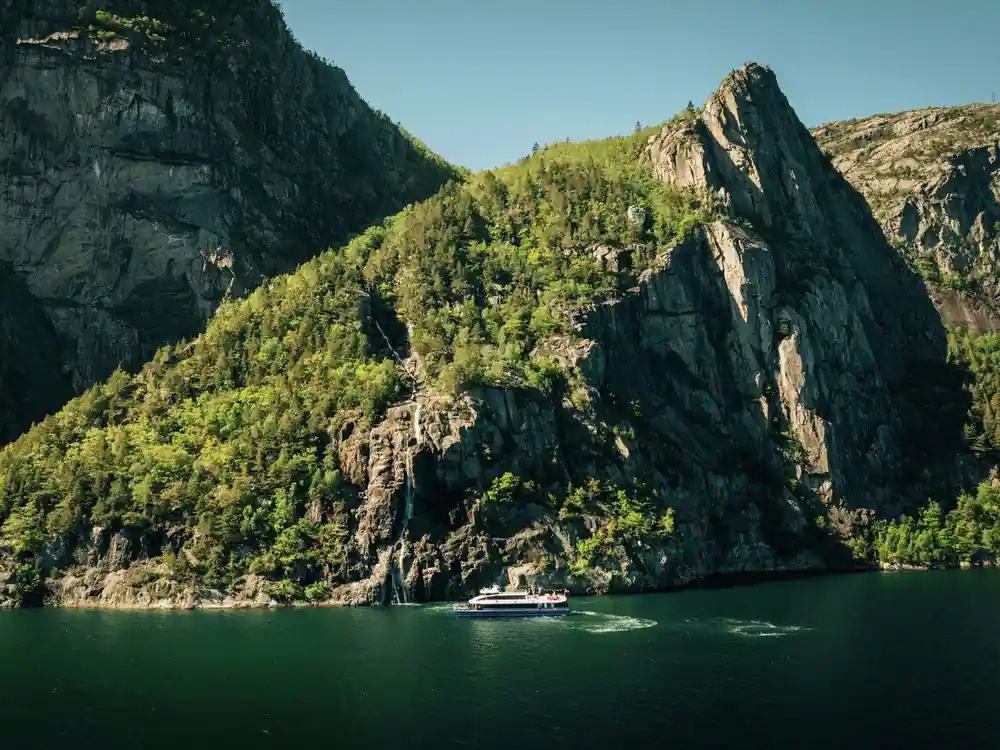
Hengjanefossen drops down the fjord wall in a long plume, and the boat slows right beneath it.
Waterfalls, stairways and old tales
Water is the other thing you notice in Lysefjord. Hengjanefossen, the waterfall that boats slow down for, is reported at around 400 metres high, falling down the fjord wall in a long, thin plume.[27] Locally it is nicknamed the Whisky Waterfall, and RIB trips stop there on a two-hour boat trip that also takes in Preikestolen from the water.[36] The waterfall appears on the electric cruise route as well, which lists Hengjanefossen Waterfall among its stops.[30]
Fjord history here has a mischievous streak. Old tales of waterfalls changing hands still get retold on board, usually with a grin about how casually such a thing could happen, and they say more about the fjord's sense of humour than about its geology. What is certain is that people have lived and worked along these shores for a very long time, farming small patches of ground, running boats and, in one famous case, climbing an extremely long staircase.
That staircase is at Flørli. The Flørli stairs consist of 4444 steps, climbing the mountainside above the fjord.[28] Further east, Lysevegen, the road that winds from Lysebotn, has 27 hairpin bends, and driving it is a slow business of second gear and short views.[37] At the head of the fjord, the year-round Kolumbus local ferry service calls at Lysebotn on its way through.[38]
Getting to the fjord and onto the water
From Stavanger the fjord is surprisingly close. The Lysefjord is 41 miles (66 km) from Stavanger, and the drive takes around an hour and a half.[39] In practice that means driving around the fjord rather than along it, through tunnels and past the turning for the Preikestolen trailhead. From Oslo, the Vy-operated Sørlandsbanen train to Stavanger takes around seven to eight hours, which is a full day of window scenery if you have the time.[40]
Public transport reaches the water too. The Kolumbus local ferry service on the Lysefjord to Lysebotn runs year-round, calling at small places along the way.[38] It is a slower, quieter way to travel, and it puts you alongside people who use the fjord as a road rather than as an attraction. If you would rather paddle than sail, Nordic Paddling organises private guided kayak tours on the Lysefjord for groups of up to 12 people.[41]
The tour boats fall into three rough families. There are silent electric cruises, larger low-emission cruises, and open RIB speedboats that cover the same water more quickly. Each one shows you the cliff from a different angle and at a different pace, and the right choice depends mostly on how much time you have and how much wind you enjoy. Whichever you pick, the route is broadly the same: out through the fjord, past Fantahala and the cliff, then a stop at the waterfall before turning back.
604 metres
Preikestolen (the Pulpit Rock) rises 604 metres above the Lysefjord in Ryfylke, which is the cliff the electric cruise sails beneath.[24]
Seeing Preikestolen from the water
Brim Explorer's electric Lysefjord cruise is a 3.5-hour silent, hybrid-electric fjord cruise from Stavanger to see Preikestolen (Pulpit Rock) from the water.[29] The listing runs from US$75 and is rated 4.62 from 9,730 reviews, with transportation scored 4.7 and value for money 4.3.[30] It is wheelchair accessible and has an audio guide in English and Norwegian, and the stops are Fantahala, Pulpit Rock and Hengjanefossen Waterfall.[30]
You can reserve now and pay later on this one, and free cancellation is available up to 24 hours in advance.[30] There are alternatives if the timing does not suit. A hybrid ship covers the Lysefjord and Preikestolen in 3.5 hours from US$83.[42] A low-emission cruise takes 2.5 hours from US$76.[31] A RIB tour to Lysefjord and Preikestolen takes 2 hours from US$126, with a live guide and an audio guide in several languages.[32] The Rødne Lysefjord cruise from Stavanger lasts 3-3.5 hours.[43]
Being on the water changes the scale of the place. From the deck, Preikestolen reads as a thin line of rock high above, with the fjord opening out behind it and the walls closing in ahead. You hear the waterfall before you see it, and the boat tends to go quiet when it slows beneath the cliff. Bring a layer you can zip up. It tends to be cooler out there than it is in Stavanger, and the best photographs are usually taken from the railing on the way back.
Seasons, weather and what to pack
The hiking trail to Preikestolen is open year-round, including during the winter off-season.[35] That does not mean every month behaves the same way. Winter brings ice on the stone steps, short daylight and a very different mountain, and the winter hike listing allows 9 hours for the day with a live English-speaking guide, from US$147, limited to 8 participants.[33] Summer brings long light and a busy trail, so an early start buys you quiet.
For the cruise, pack the way you would for a boat rather than for a city walk. A windproof outer layer, a hat you can hold onto, and shoes with grip for the deck are the practical choices. Sunscreen is worth carrying even on a grey day, because the light off the water is stronger than it looks, and it is worth bringing a bottle of water with you.
Timing is mostly about sailings. Departure times vary, so check availability to see starting times when you book.[30] If you are hiking as well as cruising, the two fit comfortably into different days, since the hike takes about 3 to 4 hours.[34] Leave the boat trip for the day you want to sit down, look up and do very little at all.
Port days, short stays and booking
If you arrive by ship, you are already in the right place. Cruise ships dock at Skagenkaien, Strandkaien or Skansekaien in Vågen, Stavanger's city-centre inner harbour.[44] The old town, the cathedral and the main shopping streets sit within a short, flat walk of the water, which makes Stavanger an easy city to explore on foot before or after a fjord trip.
Booking is flexible on the electric cruise. You can reserve now and pay later, and free cancellation is available up to 24 hours in advance, which suits anyone watching the weather.[30] The boat is wheelchair accessible, and the audio guide comes in English and Norwegian.[30] For a longer stay, a two-day adventure with Preikestolen and Kjerag hikes runs from US$1,047.[45]
For somewhere to sleep, The Bolder lodges at the Lysefjord are architecturally unique cabins in Lysefjorden, Norway, designed to minimize environmental impact.[46] They sit in the landscape rather than on top of it, which is the whole idea of a fjord stay. Book early for the summer weeks, when the days are at their longest and the fjord is at its busiest.
How long the Lysefjord boat trips last
Hours stated on the listings cited here: the Electric Fjord Cruise to Lysefjord & Preikestolen[30], the Lysefjord & Preikestolen Cruise by hybrid ship[42], the low-emission Lysefjord & Preikestolen Cruise[31] and the RIB Tour to Lysefjord & Preikestolen[32].
What a Lysefjord boat trip costs
From-prices in US dollars for the electric fjord cruise[30], the low-emission cruise[31], the hybrid ship cruise[42] and the RIB tour[32]. No separate child rate is given on these listings.
When you can go
How to plan this day
Pick your water time
Choose a sailing that leaves you time to wander the harbour afterwards; starting times vary by date.[30]
Dress for the deck
Windproof layer, grippy shoes, hat. The fjord is cooler than the city even on a bright afternoon.
Keep the camera up top
The cliff shows best from the open deck, and the waterfall arrives on one side without much warning.
Add a hike if you have a day
The Preikestolen hike is less than 10km (6.2 miles) and takes about 3 to 4 hours.[34]
Book with a flexible ticket
Reserve now and pay later, with free cancellation up to 24 hours in advance.[30]
See Preikestolen from the water on a silent electric cruise
from US$76Reserve now & pay later